Pros and Cons of Living in Biltmore
The pros and cons of living in Biltmore come down to central Phoenix access, established homes, golf and recreation amenities, and higher day-to-day ownership costs. Buyers gain proximity to the 24th Street and Camelback Road corridor, but should expect vehicle dependence, busy peak-hour streets, and serious summer cooling needs. For move-up and luxury buyers, Biltmore works best when the home’s upkeep requirements match the household’s routine and budget.
Biltmore at a Glance
Biltmore is an established central Phoenix residential area with a broad mix of condos, patio homes, townhomes, and larger detached properties near commercial services and outdoor recreation.
-
Population: Biltmore is a Phoenix neighborhood, not an incorporated city with its own Census population total. Phoenix had an estimated population of 1,665,481 in July 2025, which places Biltmore within a major employment, health care, retail, and transportation market. (U.S. Census Bureau)
-
Home price context: Phoenix’s median owner-occupied home value was $420,700 in 2024 dollars for 2020–2024. Biltmore homes often sit above that citywide benchmark because buyers may be weighing central location, renovation quality, managed-community features, larger lots, or golf-oriented surroundings.
-
Cost of living: Housing is the largest variable in a Biltmore budget. A condo may shift some exterior work into an association fee, while a detached home can add landscaping, pool service, irrigation, roof maintenance, and higher cooling demand during the warmest months.
-
Household income: Phoenix’s median household income was $81,332 in 2024 dollars for 2020–2024. That citywide figure is useful context, although Biltmore’s housing options frequently require a larger budget than the Phoenix median. (U.S. Census Bureau, 2020–2024)
-
Quality of life: The City of Phoenix identifies the 24th Street and Camelback Road area as one of Camelback East Village’s two primary cores. The surrounding area includes housing, offices, retail, restaurants, services, canal routes, and access toward nearby mountain recreation. (City of Phoenix)
Biltmore by the Numbers
Biltmore decisions benefit from neighborhood-level property research, while Phoenix-wide figures provide a consistent baseline for household planning.
-
Phoenix population: 1,665,481 residents as of July 2025.
-
Citywide owner-occupied home value: $420,700 in 2024 dollars for 2020–2024.
-
Mean commute time: 25.6 minutes for Phoenix workers in 2020–2024.
-
Median gross rent: $1,582 in Phoenix for 2020–2024.
The Pros of Living in Biltmore
Biltmore’s strongest advantages are its central setting, varied home styles, outdoor access, and proximity to a major Phoenix activity corridor.
Established homes with distinct ownership choices
Biltmore gives move-up buyers more than one way to own in central Phoenix. Condos and patio homes can reduce exterior responsibilities, while detached properties may offer private yards, pools, and more room for entertaining. A Biltmore neighborhood overview can help buyers compare local housing patterns before narrowing their search.
A central Phoenix daily routine
The 24th Street and Camelback Road area is one of Camelback East Village’s primary cores, with nearby offices, retail, restaurants, and services. That setting can reduce the distance between home and recurring errands for households whose work and routines are concentrated in Phoenix. (City of Phoenix)
Recreation near residential streets
Biltmore residents can reach canal-side routes for walking, running, and biking, while mountain trail access is nearby for more strenuous outdoor time. The City of Phoenix’s Grand Canalscape supports a multi-use route along the Grand Canal for recreation and active transportation.
Golf-oriented surroundings
Arizona Biltmore Golf Club includes the Estates Course and the Links Course. Buyers who play regularly, or who value the open visual character of golf-adjacent streets, may find that setting meaningful when comparing properties with similar square footage.
Access across Phoenix
Biltmore’s location can work well for professionals with trips across Phoenix because State Route 51 and major east-west corridors are nearby. The advantage is not that driving disappears. It is that buyers can choose a central starting point rather than a location farther from many everyday destinations.
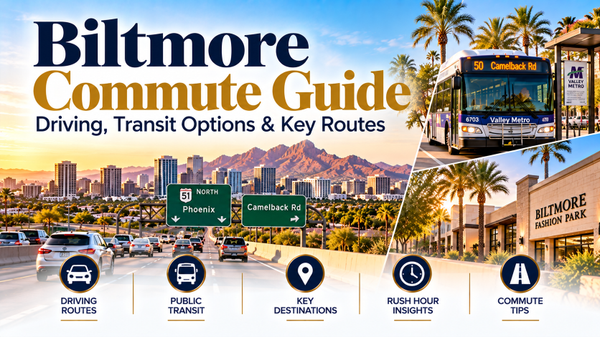
For professionals and relocating buyers, understanding everyday travel is an important part of choosing where to live. While Biltmore offers central Phoenix access, commute times can vary depending on traffic, destination, and the time of day. Explore our closer look at commuting from Biltmore to nearby Phoenix destinations to better understand major routes, travel considerations, and how the neighborhood may fit your daily routine.
The Cons of Living in Biltmore
Biltmore’s main trade-offs are higher carrying costs, traffic friction, regular vehicle use, and heat that affects both lifestyle and utility planning.
Higher recurring ownership costs
Biltmore is not a low-cost entry point for most buyers. In addition to financing and insurance, households may need to account for association dues, landscaping, pool care, roof maintenance, and repairs that can differ substantially by property age and type.
Busy commercial corridors
Camelback Road and 24th Street serve offices, retail, hotels, restaurants, and residential areas. The location is convenient, but trips through the corridor can take longer during peak work and dining periods.
Most routines require a car
Biltmore has walkable pockets, particularly around commercial destinations, but most households rely on a vehicle for groceries, school drop-offs, medical appointments, and many work trips. Buyers looking for a fully walkable daily routine may find the area limiting.
Summer heat has practical costs
Phoenix identifies May through September as its operational heat season. Reliable air conditioning, shaded parking, efficient windows, and realistic outdoor schedules are practical property considerations rather than optional upgrades. (City of Phoenix Heat Response Plan)
Biltmore vs Nearby Areas: Key Comparisons
| Comparison Point | Biltmore | Other Established Central Phoenix Areas | Newer Outer Phoenix Areas |
|---|---|---|---|
| Home price | Often upper-tier, especially for renovated and golf-adjacent homes | Varies by lot size, condition, and street | Varies by builder, community amenities, and distance from the core |
| Cost of living | Housing, cooling, and upkeep can be substantial | Older-home maintenance can be a larger factor | Community fees and longer driving costs can be more significant |
| Commute pattern | Central access, but busy local corridors | Depends on proximity to major roads and employment routes | Often requires longer drives to central destinations |
| School considerations | Options depend on the specific address and enrollment boundaries | School options vary by individual campus and program | Options vary by community and assigned schools |
| Safety considerations | Conditions differ by street, lighting, parking, and access design | Conditions vary by block and property type | Conditions vary by neighborhood layout and local conditions |
Phoenix-wide population, housing, rent, and commute benchmarks are from the U.S. Census Bureau for 2020–2024 and July 2025. Neighborhood-level conditions should be evaluated property by property.
Who Biltmore Is a Great Fit For
Biltmore is a strong match for buyers who value central Phoenix access and can choose a home type that fits their preferred level of maintenance.
Move-up buyers balancing space and location
Move-up households can compare patio homes, larger condos, managed residences, and detached properties without leaving the central Phoenix setting. This can suit buyers who want more room while remaining near the Camelback Road corridor.
Luxury buyers focused on established settings
Luxury buyers who value architectural variety, mature landscaping, golf-adjacent surroundings, and private outdoor space may find Biltmore compelling. The best fit is often a property whose pool, yard, roof, and cooling systems align with the owner’s appetite for maintenance.
Relocating professionals
Relocating homeowners with work routes through Phoenix may appreciate access to State Route 51 and nearby offices and services. This profile fits households comfortable with driving as part of work, errands, and recreation.
Lock-and-leave owners
Some condos and patio-home communities can suit owners who prefer fewer exterior responsibilities. Buyers should compare association rules, parking, storage, exterior maintenance duties, and whether the property supports extended time away.
Who Might Want to Look Elsewhere
Biltmore may be a poor fit for buyers whose highest priority is dense, fully walkable urban living. Restaurants and retail are nearby, but most households still use a vehicle for a meaningful share of daily trips.
It may also be a weak match for buyers who need the lowest possible monthly housing cost. Purchase prices, community fees, cooling, insurance, and property upkeep can strain a budget even when the home is not especially large.
People who strongly prefer mild summers should be direct about the climate trade-off. Heat affects outdoor plans, utility consumption, vehicle comfort, and the features that matter most in a home.
-
Biggest Pro: Biltmore combines central Phoenix access with established homes, golf-oriented surroundings, and nearby recreation.
-
Biggest Con: Higher carrying costs, vehicle dependence, corridor traffic, and summer heat require realistic planning.
-
Best Fit For: Move-up and luxury buyers who value location and can match the property’s upkeep demands to their lifestyle.
-
Market Note: Compare community fees, cooling systems, roof responsibility, parking, and maintenance obligations alongside the asking price.
Cost of Living in Biltmore: What to Actually Budget For
Biltmore households should budget around the specific home and daily routine, not just the purchase price. A monthly ownership plan can include financing, property taxes, insurance, association dues, landscaping, pool care, irrigation, repairs, and electricity for cooling.
Phoenix’s median gross rent was $1,582 for 2020–2024, while median selected monthly owner costs with a mortgage were $1,847 in the same period. These are citywide reference points, not Biltmore-specific estimates, so a household should treat them as budget context rather than a property quote. (U.S. Census Bureau, 2020–2024)
The property type changes the monthly picture. A condo may include exterior maintenance through association dues, but buyers should confirm what the fee actually covers. A patio home can offer a middle ground between private space and shared maintenance. A detached home can provide more control, while also placing roof, HVAC, yard, pool, and irrigation decisions directly on the owner.
Utilities deserve special attention during the heat season. HVAC age, insulation, window quality, shade, pool equipment, and thermostat settings can materially affect electricity use. Transportation also belongs in the budget because most trips for groceries, appointments, and commuting involve a vehicle.
Ready to See If Biltmore Is the Right Move?
The pros and cons of living in Biltmore come down to central access and established housing versus higher costs, driving, and summer heat. Call Brian Eastwood at 1-602-330-6813 to discuss how Biltmore fits your priorities and preferred home style.
Frequently Asked Questions About Living in Biltmore
Is Biltmore a good place to live?
Biltmore can be a good place to live for buyers who want established homes near central Phoenix offices, retail, recreation, and major roads. The City of Phoenix identifies 24th Street and Camelback Road as one of Camelback East Village’s primary cores, supporting a practical routine for households that value nearby services. (City of Phoenix)
What are the biggest downsides of living in Biltmore?
The main drawbacks are higher ownership costs, busy traffic around Camelback Road and 24th Street, regular vehicle use, and intense summer heat. Buyers should also compare association responsibilities and major system condition because the monthly demands differ widely by property type.
Is Biltmore affordable compared to nearby areas?
Biltmore is generally a higher-cost housing choice than many Phoenix neighborhoods, particularly for renovated homes and golf-adjacent properties. Phoenix’s citywide median owner-occupied home value was $420,700 in 2024 dollars for 2020–2024, though individual Biltmore properties can vary substantially by style, condition, and location. (U.S. Census Bureau, 2020–2024)
What is the job market like in Biltmore?
Biltmore benefits from its position near a central Phoenix office, retail, and service corridor. It can be especially practical for professionals whose work requires travel across Phoenix or access to State Route 51.
Is Biltmore safe?
Safety conditions vary by street, community layout, lighting, parking design, and property access controls. Buyers should review current public safety information and visit prospective homes at different times of day to understand the immediate surroundings.
Categories
Recent Posts